
MHS 2026:
Jurors, Selected ARtists, & Award Winners
Follow Gabe on Instagram
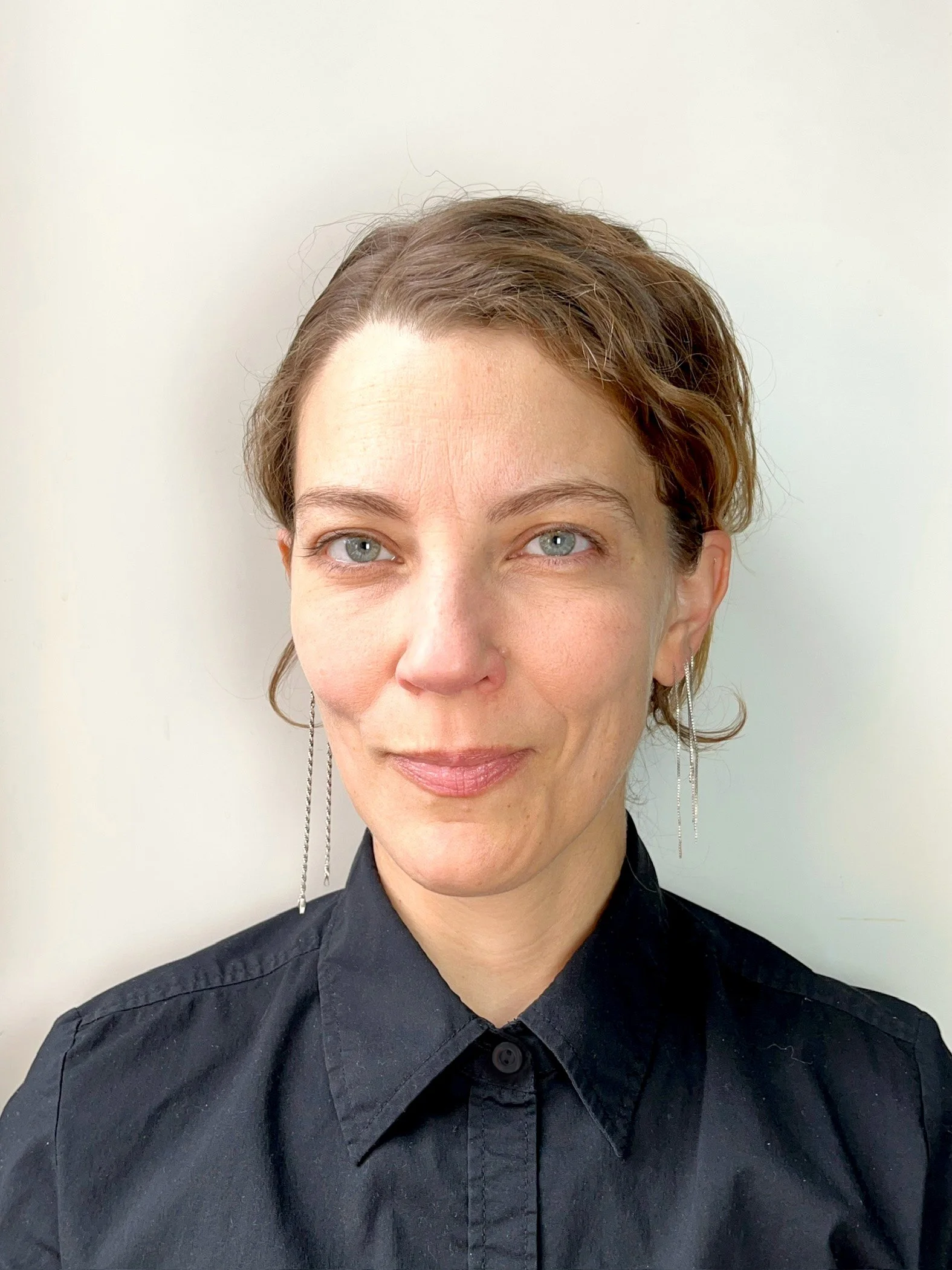
MHS Juror: Gabe Duggan
Gabe Duggan (they/them, b. Buffalo, NY) is the recipient of awards, fellowships and grants including Field Projects’ MUSKEG and ENDS WELL (Upstate Art Weekend), a Juror’s Prize at Art on the Trails (MA), the Integrated Coastal Programs Coastal Fellowship (NC), and more. Duggan has had residencies at Watershed Studios (Gaillimh, IE), Fish Factory Creative Center (Stöðvarfjörður, IS), Sculpture Space Inc. (NY), Praxis Fiber Workshop (OH), amongst others. They are currently an associate professor at East Carolina University.
Artist Statement:
“I construct installations in three-dimensional space through tension and repetition that engage with four-dimensional space through ephemerality or perpetuation. Laboring tediously over precarious systems I challenge definitions of functionality and permanence. In violence/consent (2024), the body is used as a subtractive technology upon the earth's surface. This work etches a mark regardless of consent by the receiving species. Related to desire paths and meditation labyrinths, violence/consent enlists trauma and reparations.”
Follow Nneka on Instagram
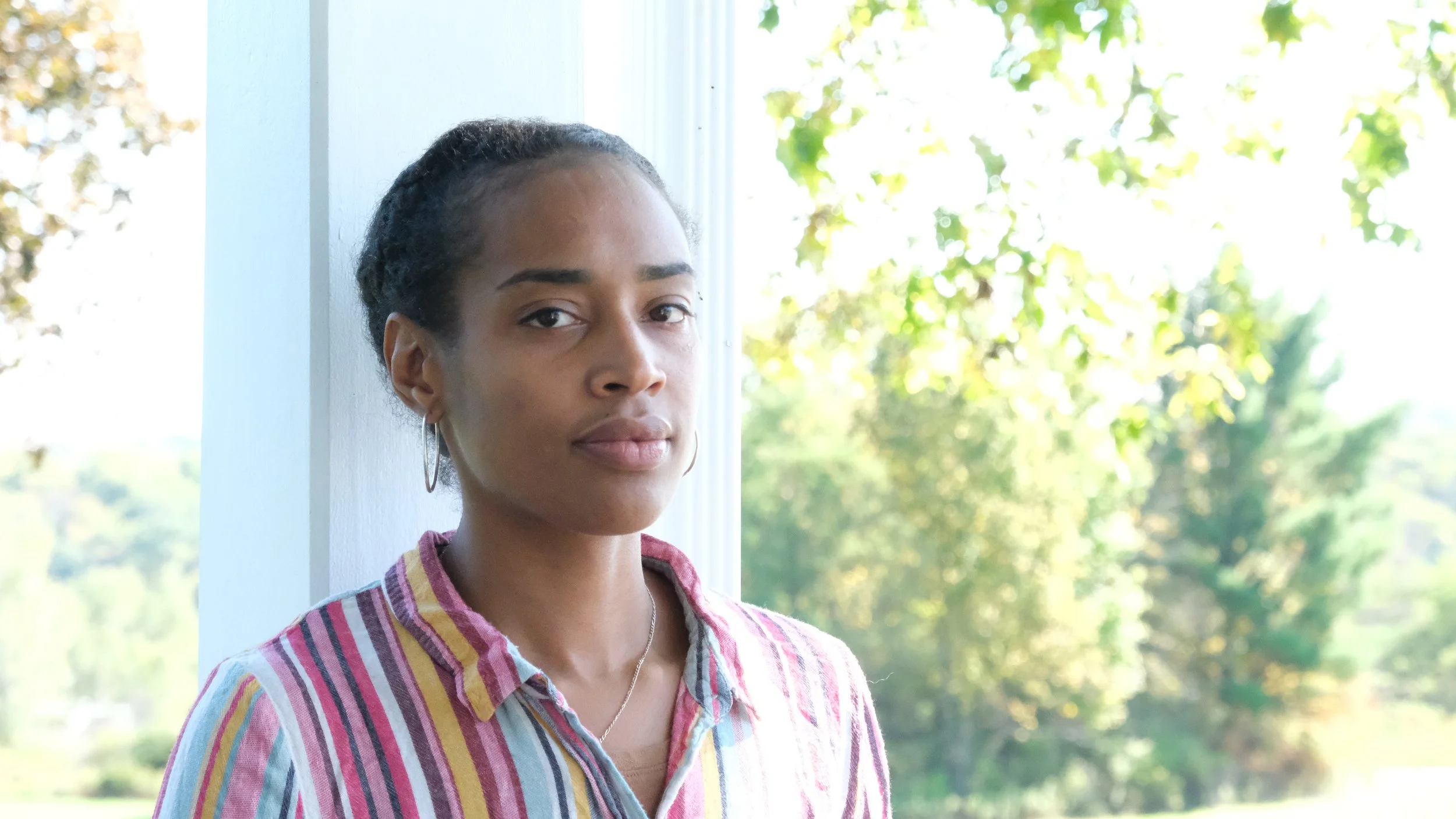
MHS Juror: Nneka Kai
Nneka Kai (she/her) is an interdisciplinary artist, writer, curator, and educator based in upstate New York. Kai is the recipient of the 2023 Artadia Award (Atlanta, GA) and has guest-curated with the Art Institute of Chicago’s Textiles Department. Her work has been exhibited nationally across Atlanta, Chicago, Berkeley, and New York. Kai currently teaches sculpture at Pratt Munson, NY.
Artist Statement:
“My studio practice begins with the question: What is the free Black feminine form? I explore this inquiry through hair—as material, language, and conceptual framework—using interdisciplinary methods that include fiber, sculpture, and performance. Drawing from textile techniques such as braiding, coiling, and stitching, I reimagine these processes in dialogue with found objects creating sites of friction where vulnerability and resistance coexist. Through abstraction, my work resists and interrogates how the past, present, and future remain precariously intertwined, offering space to consider how materiality might be continually negotiated.”
MHS 2026 Selected ARtists
Vasfie Abderafi
Cassie Arnold
Rachel Ivy Clarke
Lynne Dees
Tyler Germaine
Nosheen Iqbal
Kristine Leathers
Vijay Paniker
Hannah Reynoso Toussaint
S. sanchez
Railey Smith
Jason Thing
Merrie Wright
Hadi Asgharpour
Christine Adame
McConnell Brown
Deborah Corsini
Jeff Felderhoff
Kelly Riek
Tamara Rafkin
Hurieh Heravi
zara Shahi
Lauren Doorish
Jack Hein
Gaurii S KumAar
Laura Lanier
Kristin LeVier
Izanna Perry
Jóh Ricci
Suzanna Scott
Bethany Springer
Martha Underriner
Carolina Yáñez
Manikya Sai Tejaswini Vallabhajosyula
Joe Taylor
Jasmine Best
Kat Cole
MHS Award Winners
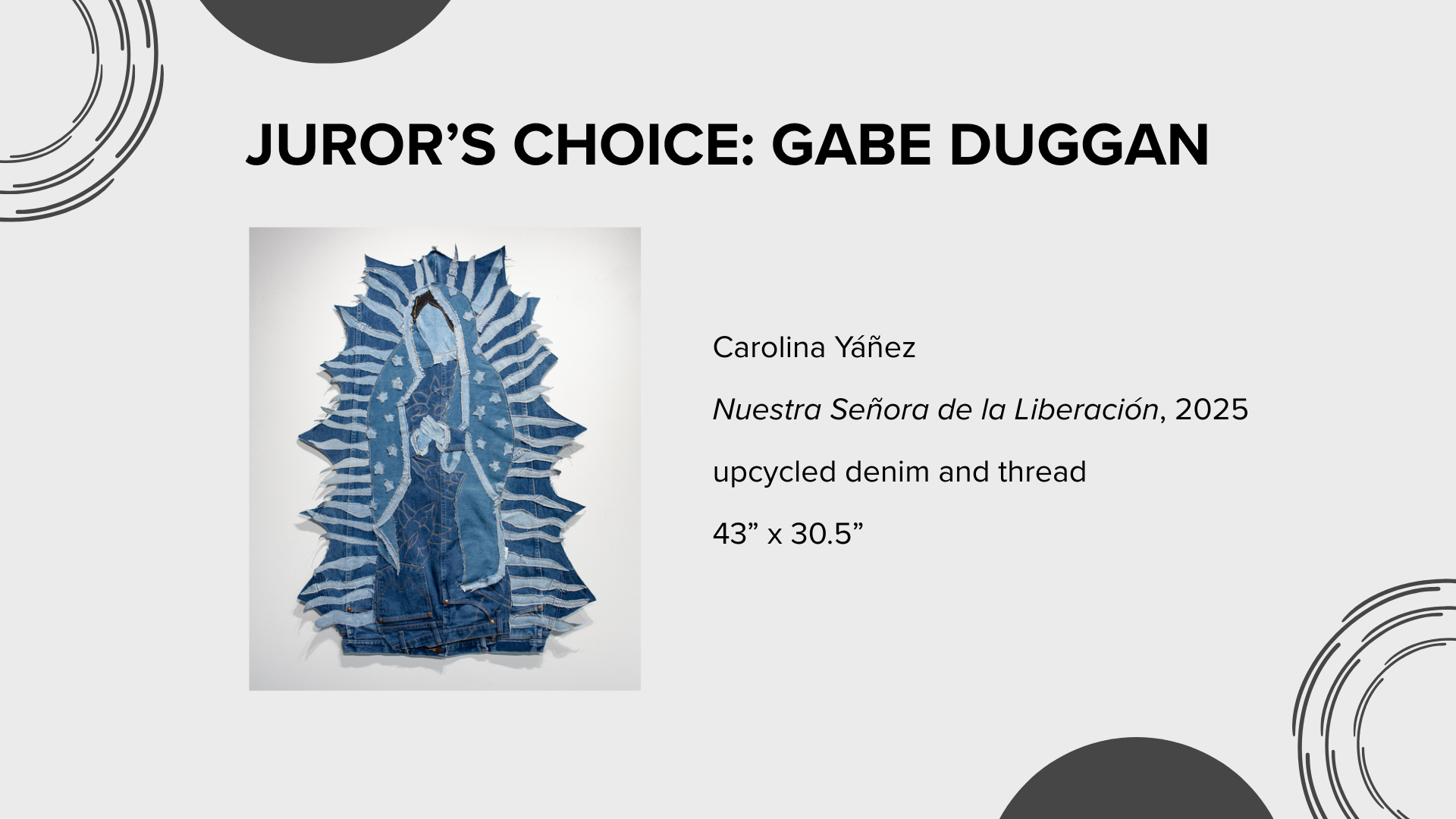
Juror’s Choice Award, Chosen by Gabe Duggan:
Carolina Yáñez, Nuestra Señora de la Liberación
“In Nuestra Señora de la Liberación (Our Lady of Liberation), I created La Virgen de Guadalupe as a nod to my Mexican culture and Catholicism, as well as the role the iconography plays in Mexican liberation. I am reminded of how Indigenous Mexicans and Mestizos used her symbol as one for independence from the Spanish empire, and how Latine students and field workers erect her image during protests. With the ongoing anti-Mexican sentiments promoted by GOP leaders in Texas and at the federal level, I correlate this image with the belief that tyranny and oppression are nothing that we have not experienced before.”
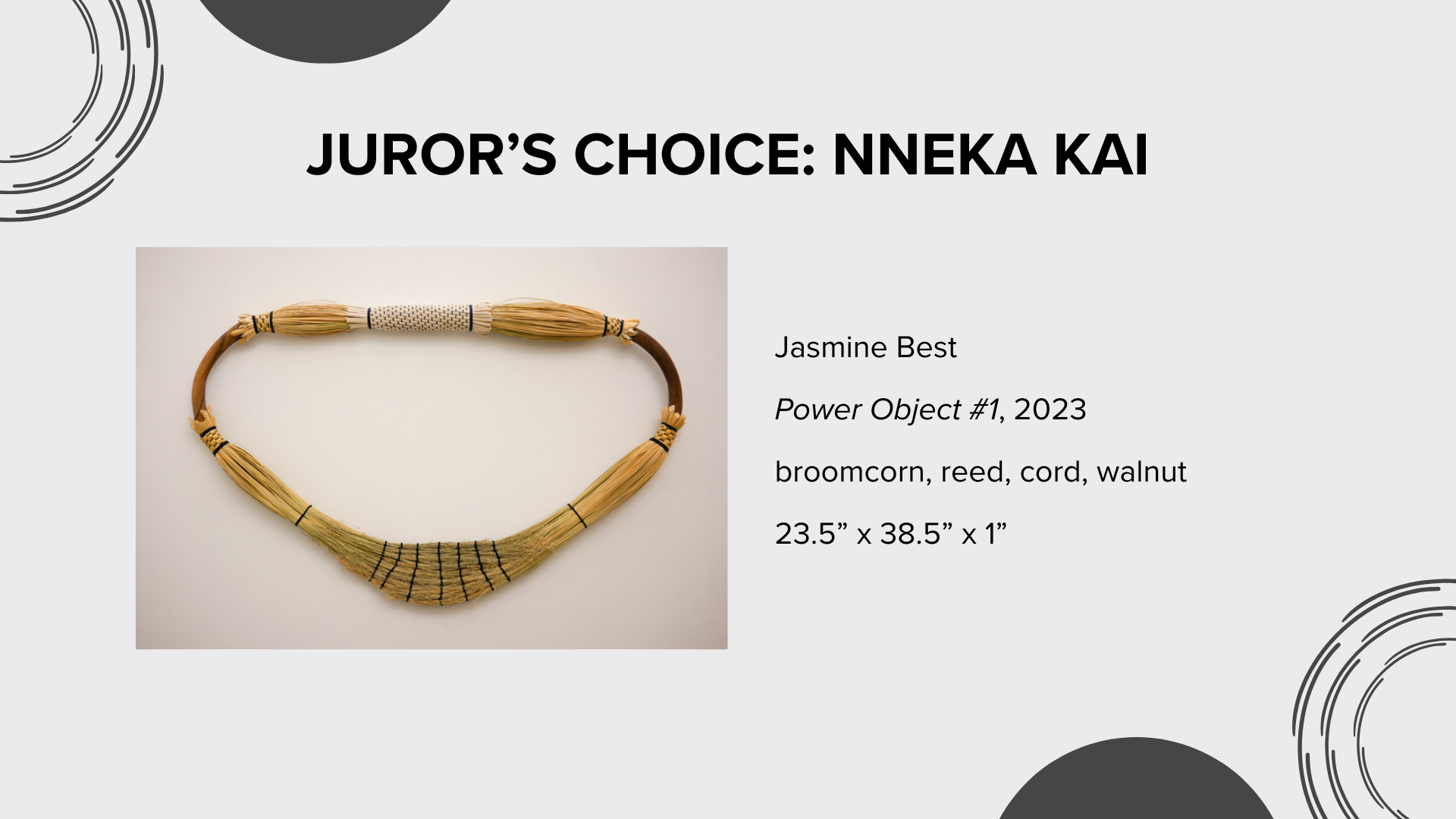
Juror’s Choice Award, Chosen by Nneka Kai:
Jasmine Best, Power Object #1
“Best combines personal experiences and signifying practices through storytelling of the complexities of how Black people have wrestled with how blackness becomes Americana. Their research-based practice investigates complicated social capital dynamics entangled with narratives where race and gender intersect.
Best reinterprets folk histories through personal corporeal archeology of the Southern African American storytelling/audience canon. Best deep reads the gendered implications of archived narratives but also the gendered influence of the storyteller, and the audience. These improvisational applications are focused on Black subjectivity’s relationship to nonconformity and individual future-facing liberatory practices. Best uses fibers to turn the everyday into the supernatural and legitimize that which can not be easily noted in traditional Western institutions.”
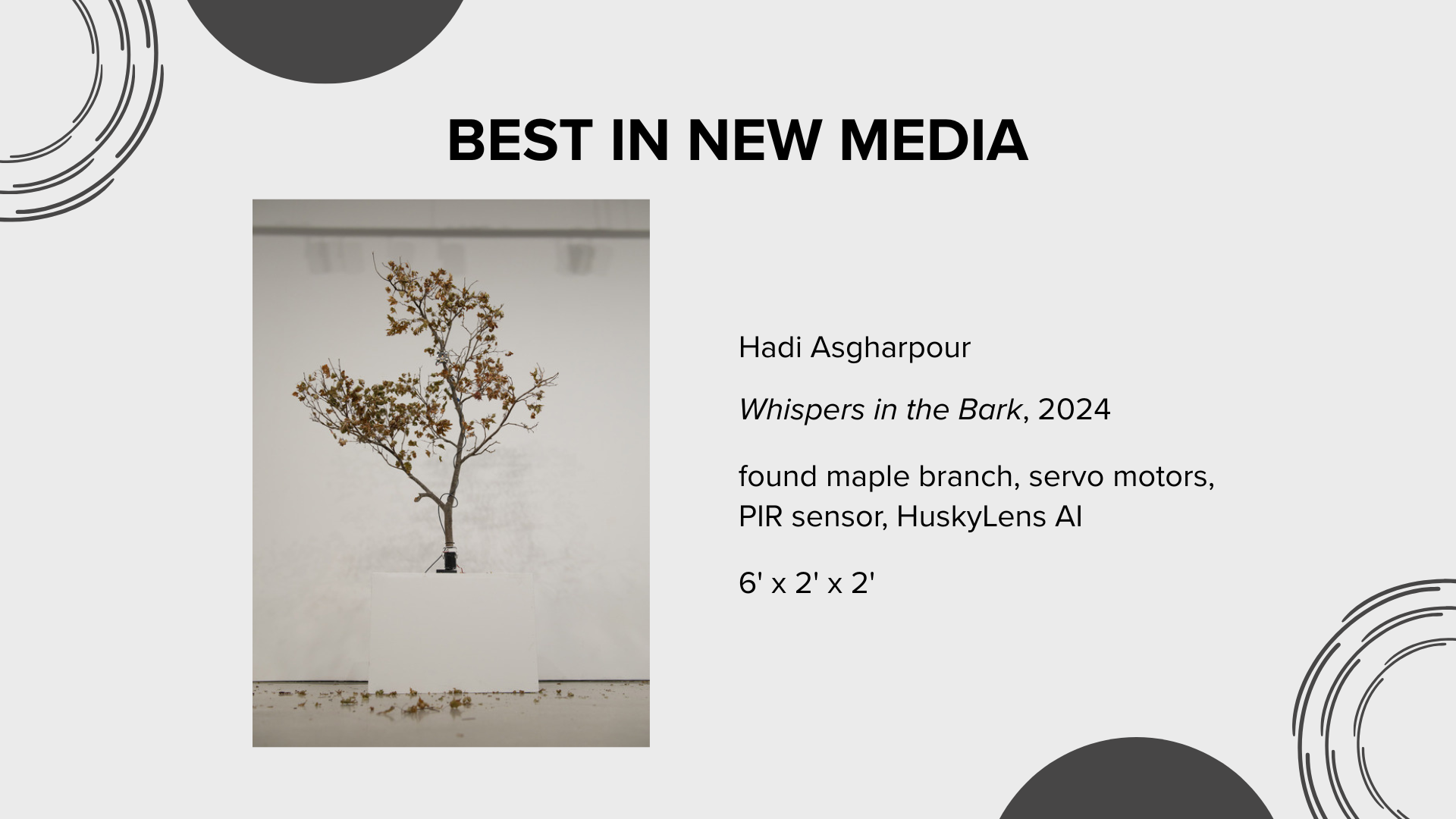
Best in New Media:
Hadi Asgharpour, Whispers in the BArk
“My work explores the emotional weight of environmental loss through interactive installations grounded in personal memory. Growing up in Guilan, Iran, I witnessed the disappearance of rivers, forests, and marine life. These experiences drive my practice, which combines sculpture, reclaimed wood, visible electronics, and sensor-based interaction to create poetic spaces that reflect on ecological grief and resilience.
In Whispers in the Bark, a tree branch fitted with servo motors and sensors responds to viewers’ presence, turning toward them as if asking for care. With this piece, I seek to create a dialogue between human and non-human entities, where the tree is not a backdrop but an active partner in the exchange. By engaging viewers physically and emotionally, I aim to foster awareness of the Anthropocene and the fragile relationships we hold with nature, especially for those who know displacement and environmental change as lived realities.”
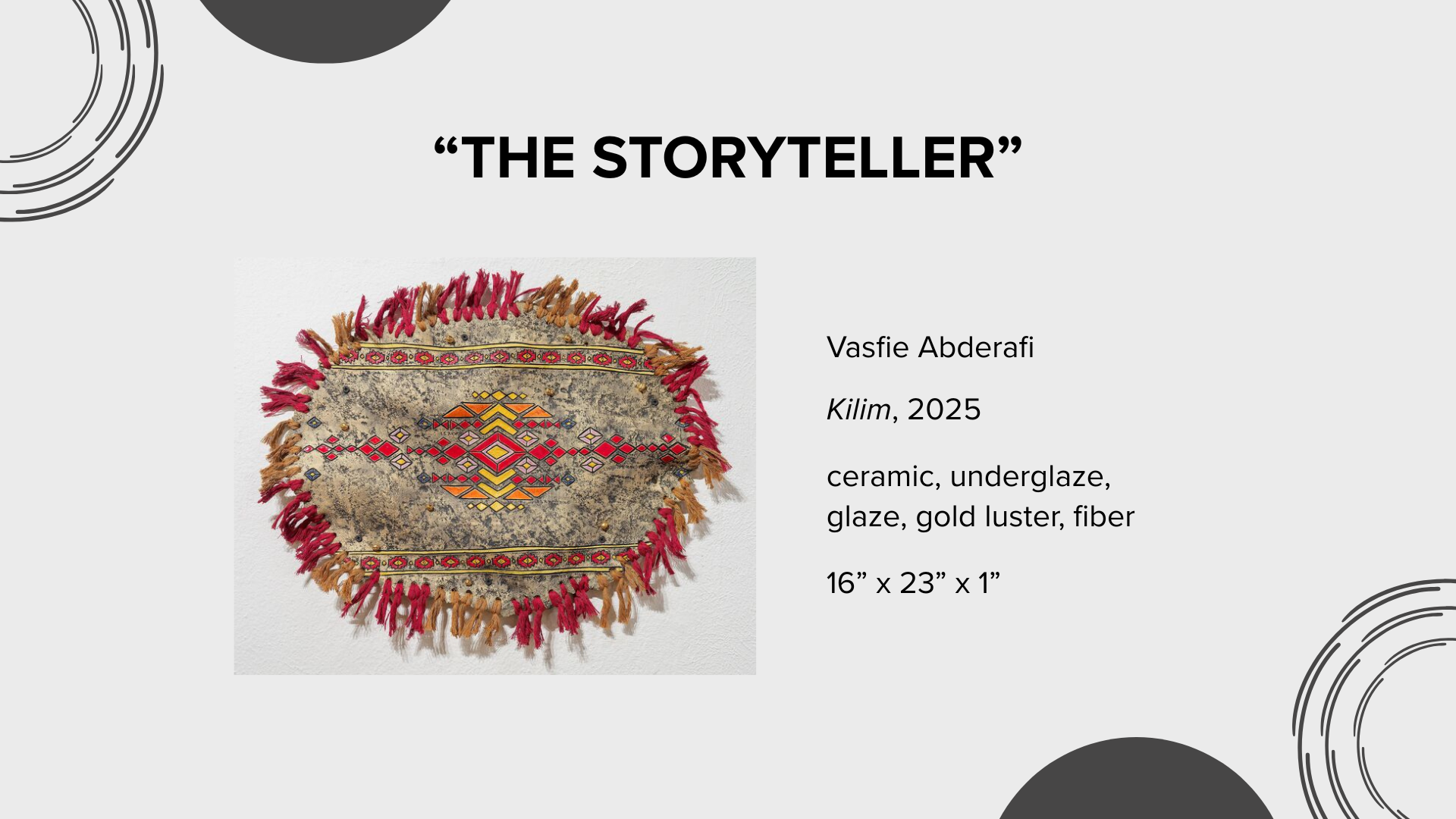
“The Storyteller”:
Vasfie Abderafi, Kilim
“My work emerges from a deep well of ancestral memory rooted in the Crimean Tatar heritage of Crimea, Ukraine.
My practice is an act of cultural revival and resistance: a way to honor my lineage and give voice to a tradition nearly silenced by exile and erasure.
Using sgraffito, traditional patterns (Örnek), and hand-built clay forms, I create to remember and to preserve.
The clay holds everything: the pain of displacement, the beauty of survival, and the unbreakable threads of identity.
Let the Kilim speak–where words fall away, form remains.”
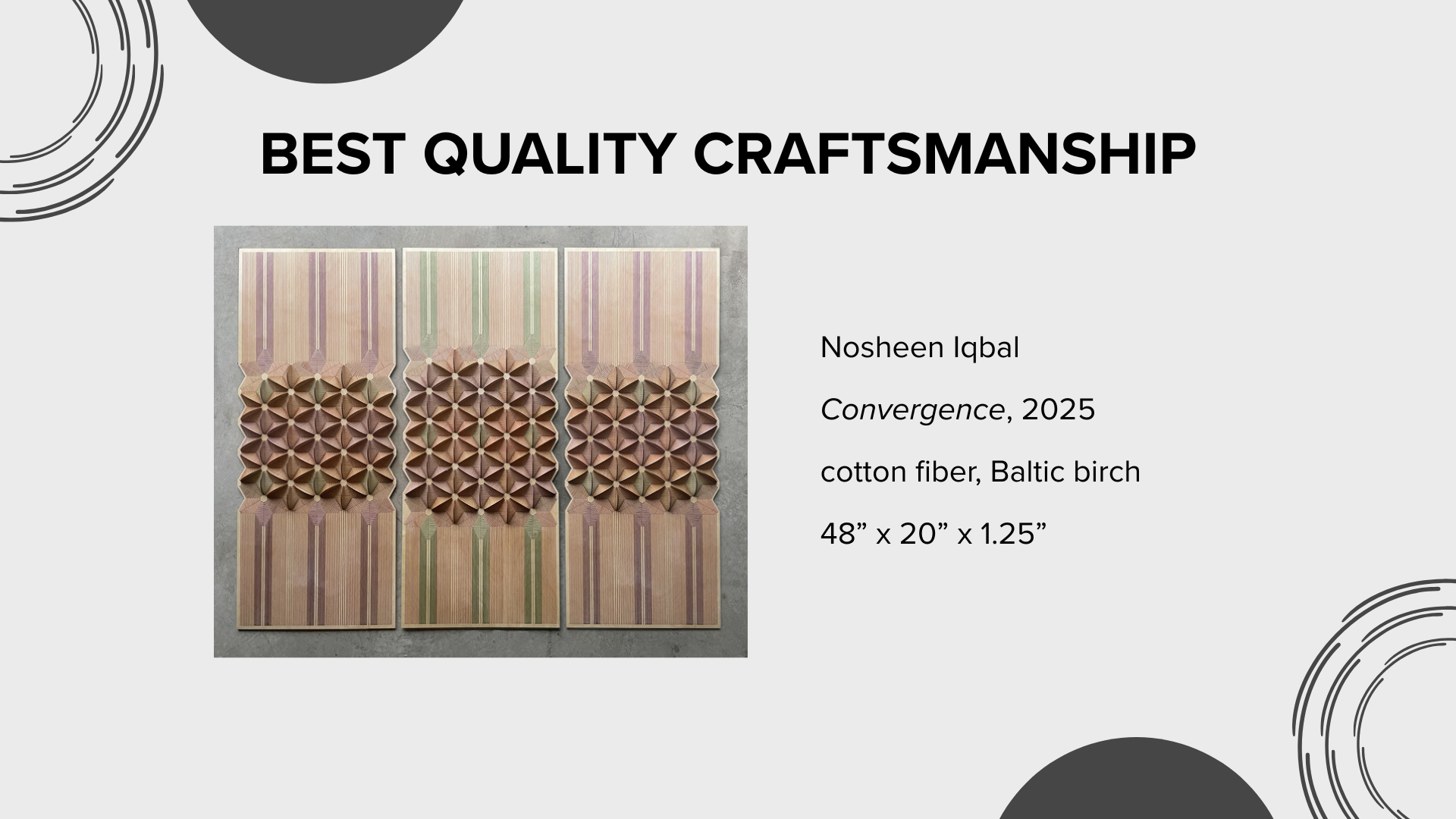
Best Quality Craftmanship:
Nosheen Iqbal, Convergence
“Nosheen Iqbal has developed a practice rooted in material tension, cultural memory, and the quiet strength of repetition. Working primarily with hand embroidery on wood, Iqbal merges domestic textile techniques with architectural surfaces to explore identity, inheritance, and self-preservation.
Drawing from her Pakistani heritage, she incorporates geometric patterning, botanical arabesques, and motifs inspired by phulkari and baagh textiles. Rather than reproducing tradition, she reimagines it through saturated threadwork and layering, constructing contemporary compositions that speak to diasporic hybridity and cultural continuity.
At the heart of her practice is the juxtaposition of softness and resistance. Expanding into sculptural and architectural formats, Iqbal creates immersive, contemplative works that invite viewers to slow down and trace the quiet power of labor and detail.”
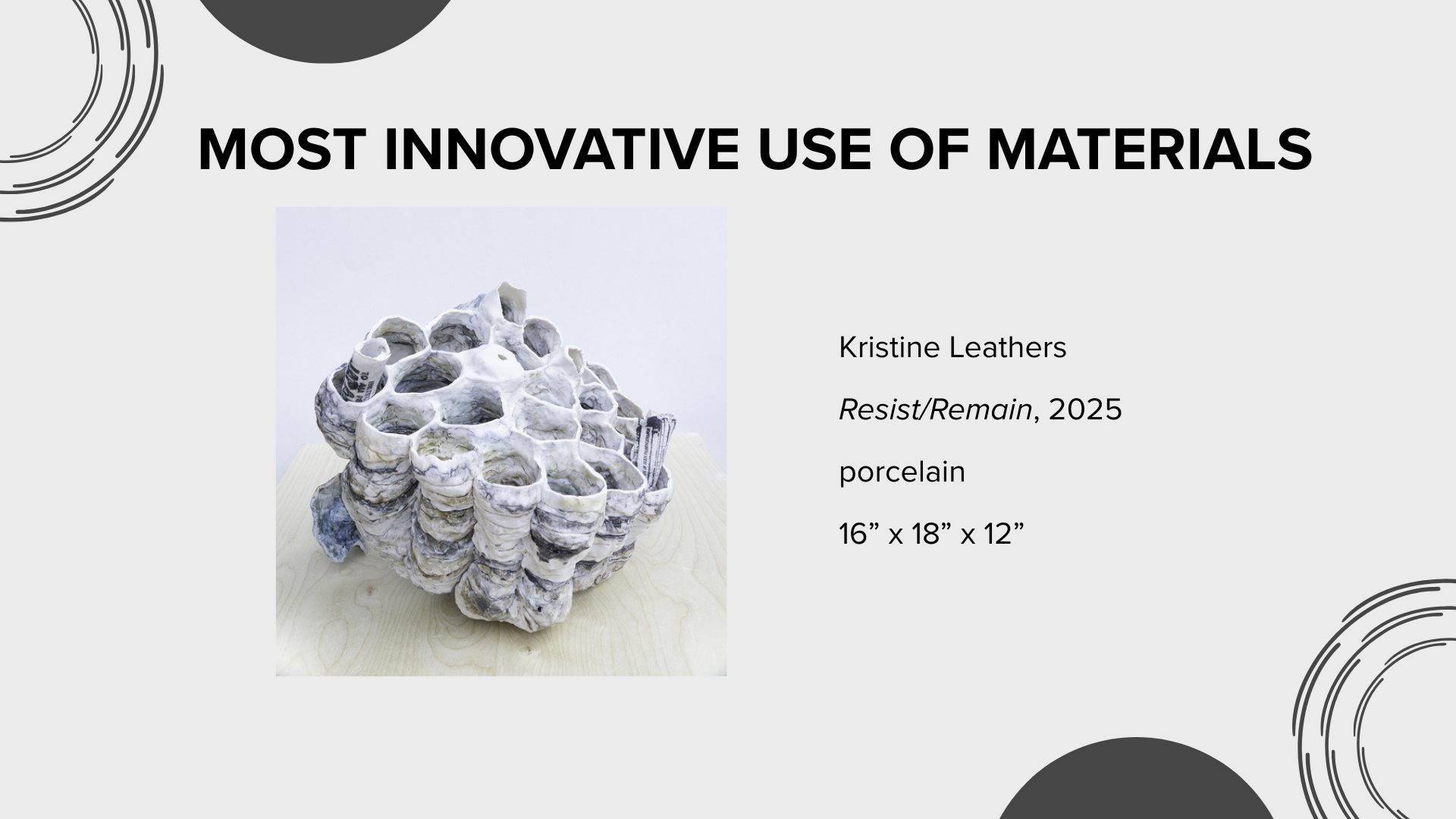
Most Innovative Use of Materials:
Kristine Leathers, Resist/Remain
“My art explores historical impacts, political decisions, and cultural influence on society and how they affect me through the form of reliquaries. My work in porcelain is an artistic collaboration with the material and the viewer. My sculptures share my stories and invite the viewer to participate in collective stories. The world is fractured, often making discussions challenging.
My works encourage questioning the social norms of politeness and sparks discourse about diversity, accepting and having compassion for others. How can we build bridges between different stories? How have we have forgotten to hold connection sacred thus creating fissures in the fabric of society? Resist/Remain is a story of my family experience.”